Aa
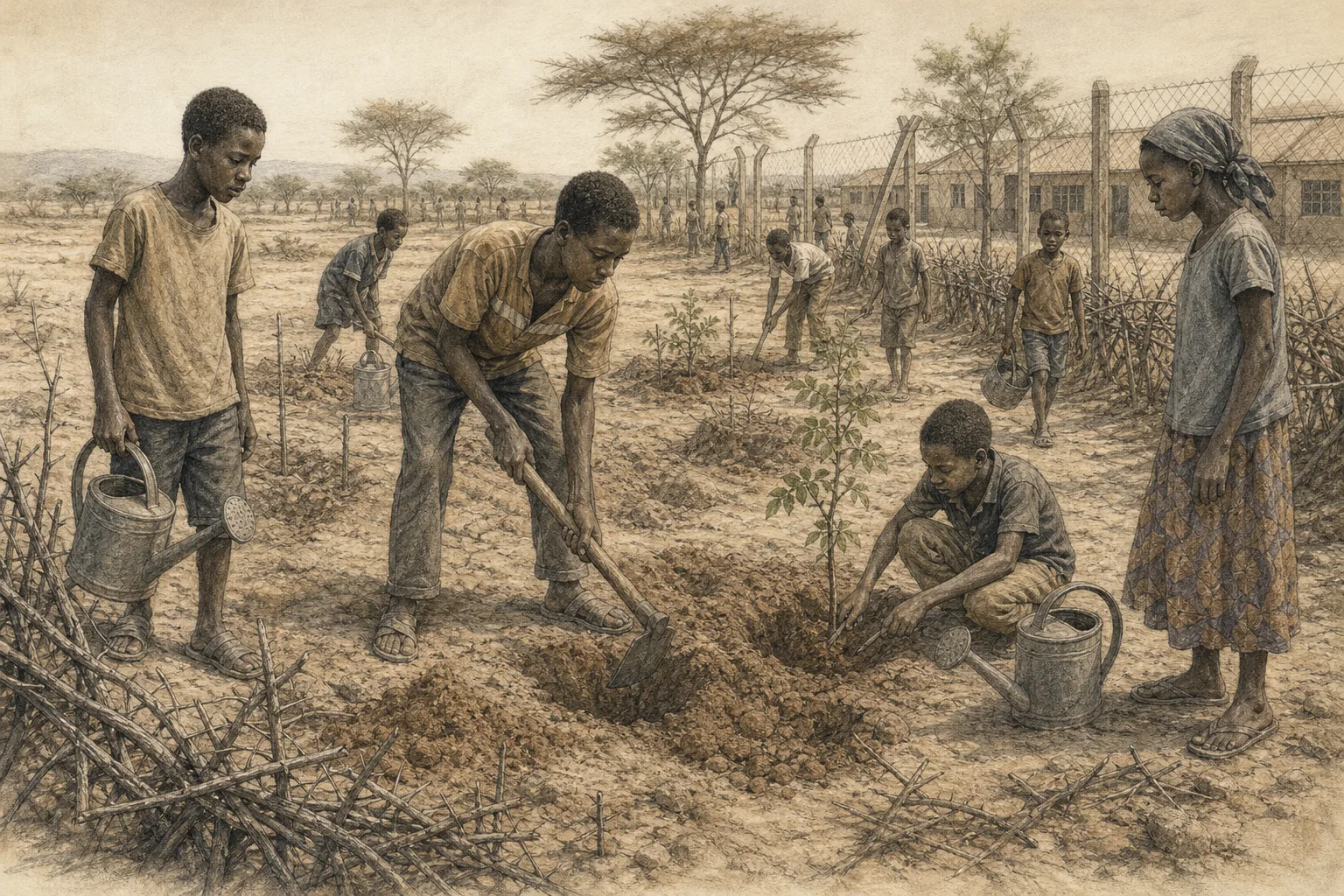
Several years later, Issa was a teenager, but he still watered the nursery before school and again after work. The first years had gone badly, yet he had not stopped.
One day, Mr. Diallo, a district agricultural worker, showed him how to make deeper planting pits and how to mix compost from leaves and manure. Issa learned that better soil could help young trees survive.
Issa began to use the new method at once. He asked his classmates to help him dig and fence a wider planting area, and the work became something the school children could do together.
Soon, the first line of trees gave shade to the children walking to school. Their path became easier to use, because the young trees were already changing the place.
Then goats broke through one fence and ate some of the young trees. When Issa saw it, he understood that weak protection could undo days of work.
He repaired the damage and put up stronger thorn barriers. He chose to improve the fence instead of giving up.
A long dry season came and killed many seedlings. The nursery was nearly destroyed, and Issa felt discouraged as if several years of work were disappearing.
Mariam told him, “The postcard was only the beginning. It was never a promise that every tree would live.” Her words helped him keep going after the loss.
Issa studied the land and learned to plant only when the rains began. He also made water-catching basins and used more mulch around each seedling.
Village women joined him to grow fruit trees near their homes because they wanted shade and food. The work spread beyond the school fence.
Later, Issa went with Amina to the district office to ask for tools and seed support. They explained that the village needed help if the planting was to continue.
An official gave Issa a small supply of watering cans and seeds, and he also allowed him to use public land near the road. With that support, Issa could expand his work beyond his own yard.
Issa kept written notes about which trees survived best. He used them to show the villagers that some species did far better than others in the dry climate.
As a young man, Issa led planting days every year with children, farmers, and teachers. Tree planting became a shared habit in the village.
By then, the schoolyard and the road held many trees, and birds and small animals had come back. The village looked and felt different from the place Issa had known as a child.
A local journalist wrote about Issa’s work. After that, the story spread beyond the village and brought him wider attention.